


What are genetic diseases?
About A genetic disease is a general term for a disease that develops due to an abnormality (mutation) present in an individual's genes. This type of disease is influenced by the patient's genotype and other genetic factors.
Genetic disorders are classified into many different types, but the main categories include.
●Monogenic Disorders
Monogenic disorders are disorders caused by mutations in a single gene.
These disorders generally follow a recessive or dominant pattern of inheritance at the gene locus.
Examples include phenylketonuria and neurofibromatosis type 1.
●Polygenic Disorders
Multifactorial genetic diseases are diseases caused by the interaction of multiple genetic mutations and environmental factors.
As a result, the risk of developing a disease varies depending on an individual's genetic predisposition.
Examples include type 2 diabetes and hypertension.
●Repeat Expansion Diseases
Repeat expansion disorders are caused by an abnormal expansion of a repeated sequence of DNA in a specific region of a gene, which prevents the gene from functioning normally and causes disease.
These disorders include Huntington's disease and myotonic dystrophy.
●Permeability
Genetic penetrance indicates the degree to which a genetic trait affects the phenotype of an individual.
In the case of complete penetrance, all individuals carrying a gene mutation will show the corresponding phenotype, whereas in the case of incomplete penetrance, the degree of influence varies from individual to individual, and the mutation may only be present in a portion of individuals carrying the gene.
●VUS (Variant of Uncertain Significance)
VUS is a term used to indicate that the functional or clinical significance of a particular gene mutation in genetic analysis is unclear at the time of testing.
Such mutations may be difficult to provide accurate information on disease risk and diagnosis.
In addition, the assessment may change in the future, requiring long-term follow-up.
Monogenic Disorders
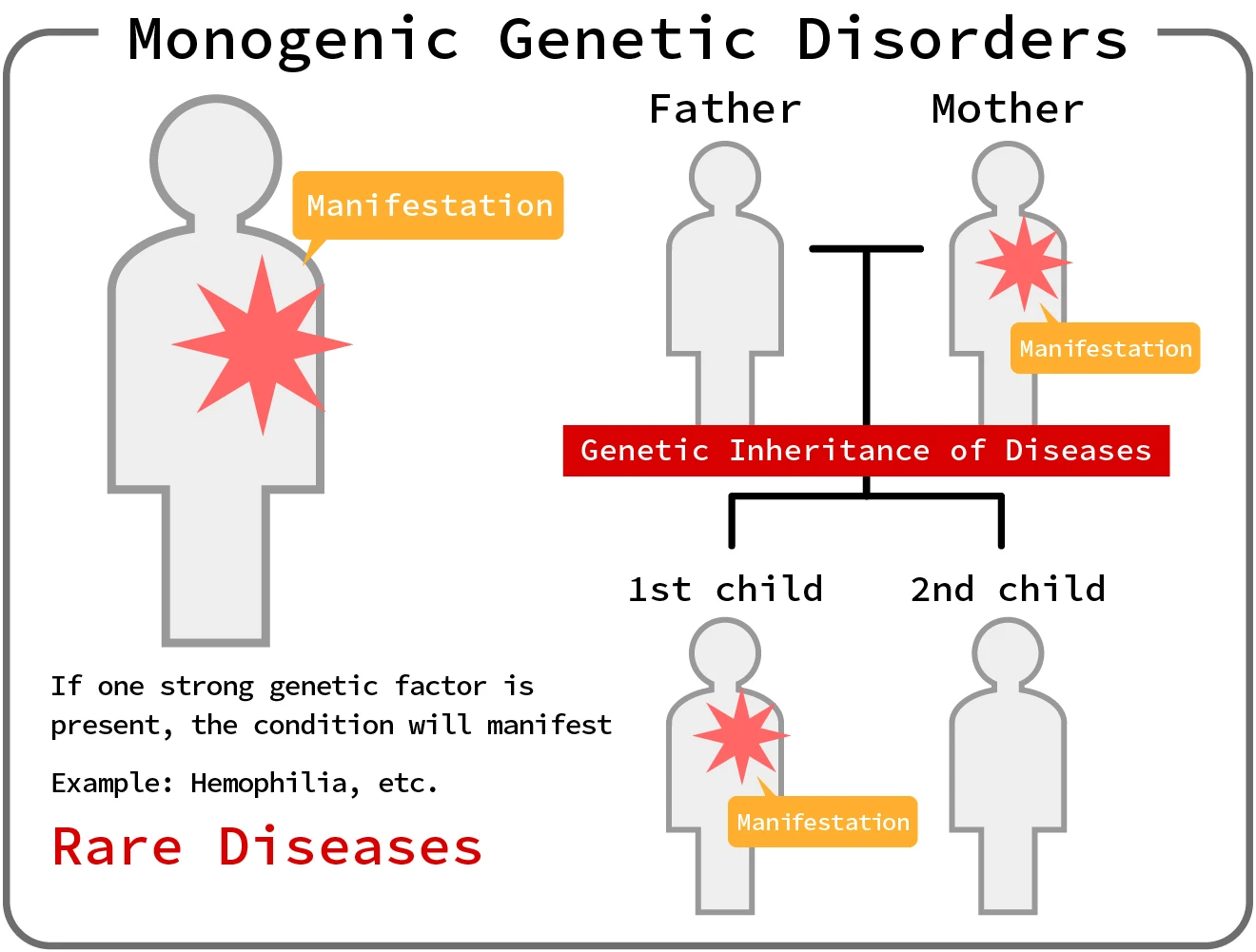
Single gene disorders are a group of disorders that develop due to mutations in individual genes.
These disorders are caused by genetic mutations (mutations such as deletions, substitutions, and insertions of bases) at gene loci and usually follow recessive or dominant inheritance patterns.
In the case of recessive disorders, if both alleles have a mutation, the disease caused by the mutation will develop. Conversely, if one allele is normal, the person will not develop the disease even if they have a mutation.
In the case of dominant disorders, the disease will be caused by a mutation in only one gene, so a child may inherit the disease if only one parent has a mutation.
Single gene disorders are caused by functional loss or mutation of a gene, so the loss or change of a specific function affects a specific part or function of the body.
Single-gene disorders are classified into three types based on their inheritance pattern.
Polygenic Disorders
Polygenic disorders are a very interesting and complex area of genetics where multiple genes are involved.
Unlike monogenic diseases where a single gene mutation causes the disease, polygenic diseases are caused by many gene mutations interacting with each other to contribute to the onset of the disease.
This page focuses on lifestyle-related diseases such as hypertension and diabetes, and provides a detailed explanation of advanced genetic research techniques such as genome-wide association studies (GWAS), single nucleotide polymorphisms (SNPs), linkage analysis, and Mendelian randomization.
