


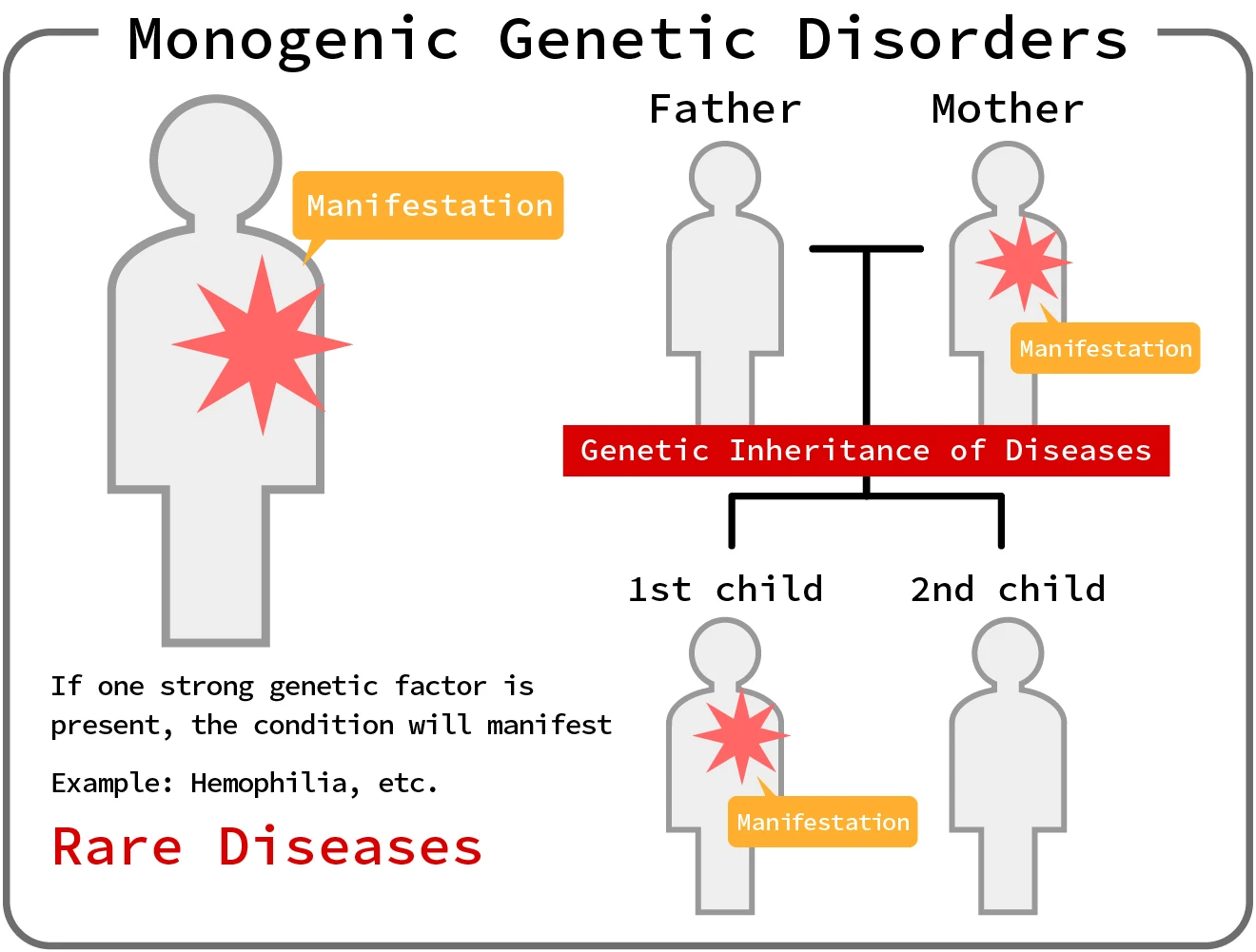
Single gene disorders are a group of disorders that develop due to mutations in individual genes.
These disorders are caused by genetic mutations (mutations such as deletions, substitutions, and insertions of bases) at gene loci and usually follow recessive or dominant inheritance patterns.
In the case of recessive disorders, if both alleles have a mutation, the disease caused by the mutation will develop. Conversely, if one allele is normal, the person will not develop the disease even if they have a mutation.
In the case of dominant disorders, the disease will be caused by a mutation in only one gene, so a child may inherit the disease if only one parent has a mutation.
Single gene disorders are caused by functional loss or mutation of a gene, so the loss or change of a specific function affects a specific part or function of the body.
Single-gene disorders are classified into three types based on their inheritance pattern.
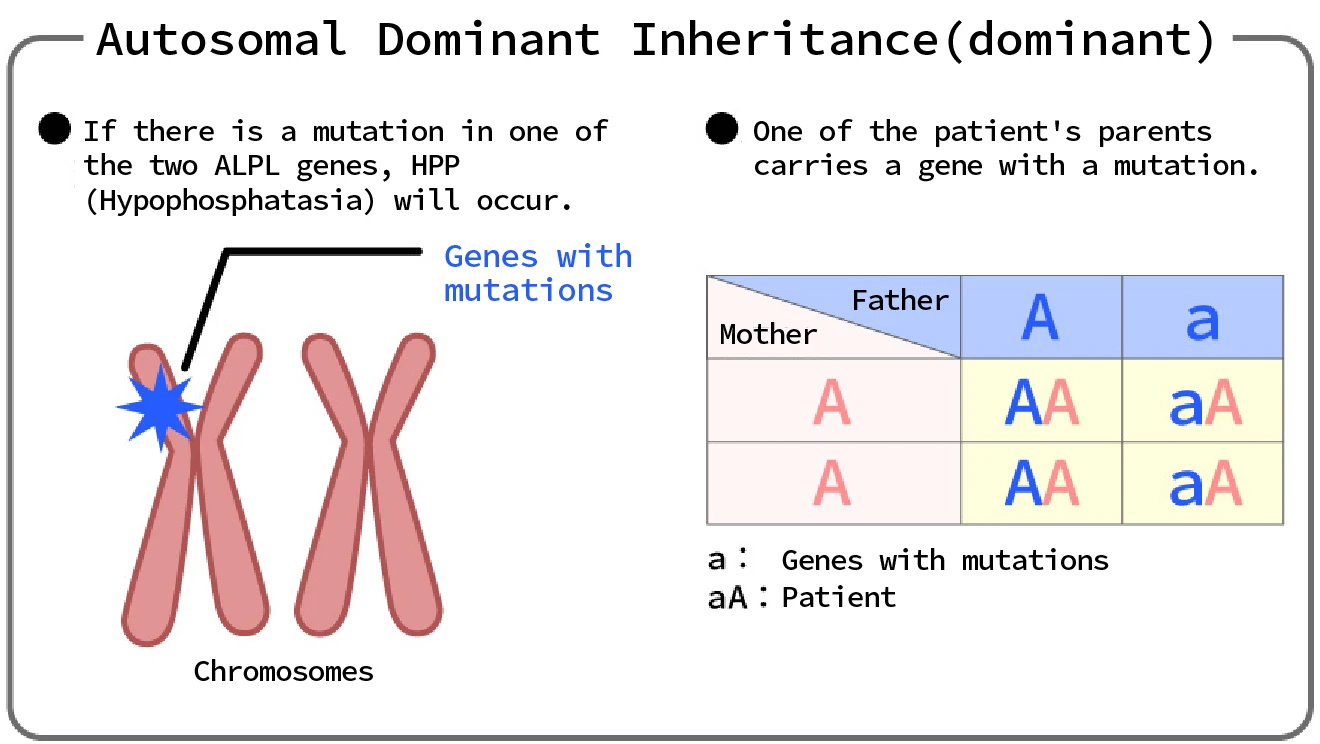
(1) Autosomal dominant (dominant) genetic disease
...If there is an abnormality in one of the paired genes on an autosomal chromosome, the disease will develop.
In dominant inheritance, only one copy of an abnormal gene (allele) is needed to cause a disease. This means that the dominant allele has a phenotypic advantage over the recessive allele.
[Phenotypic Expression]
In dominant inheritance, the abnormal phenotype appears in both heterozygotes (Aa) and homozygotes (AA), where "A" represents the abnormal allele and "a" represents the normal allele.
[Patterns of inheritance]
Dominant disorders have a 50% chance of being transmitted from parent to child because a parent with an abnormal allele (Aa) has a 50% chance of passing it on to their child.
[Example]
Huntington's disease: Huntington's disease is a neurodegenerative disorder caused by dominant gene mutations that contain an abnormal expansion of CAG repeats.
Familial hypercholesterolemia: Mutations in the LDL receptor gene lead to abnormal cholesterol metabolism, resulting in hypercholesterolemia.
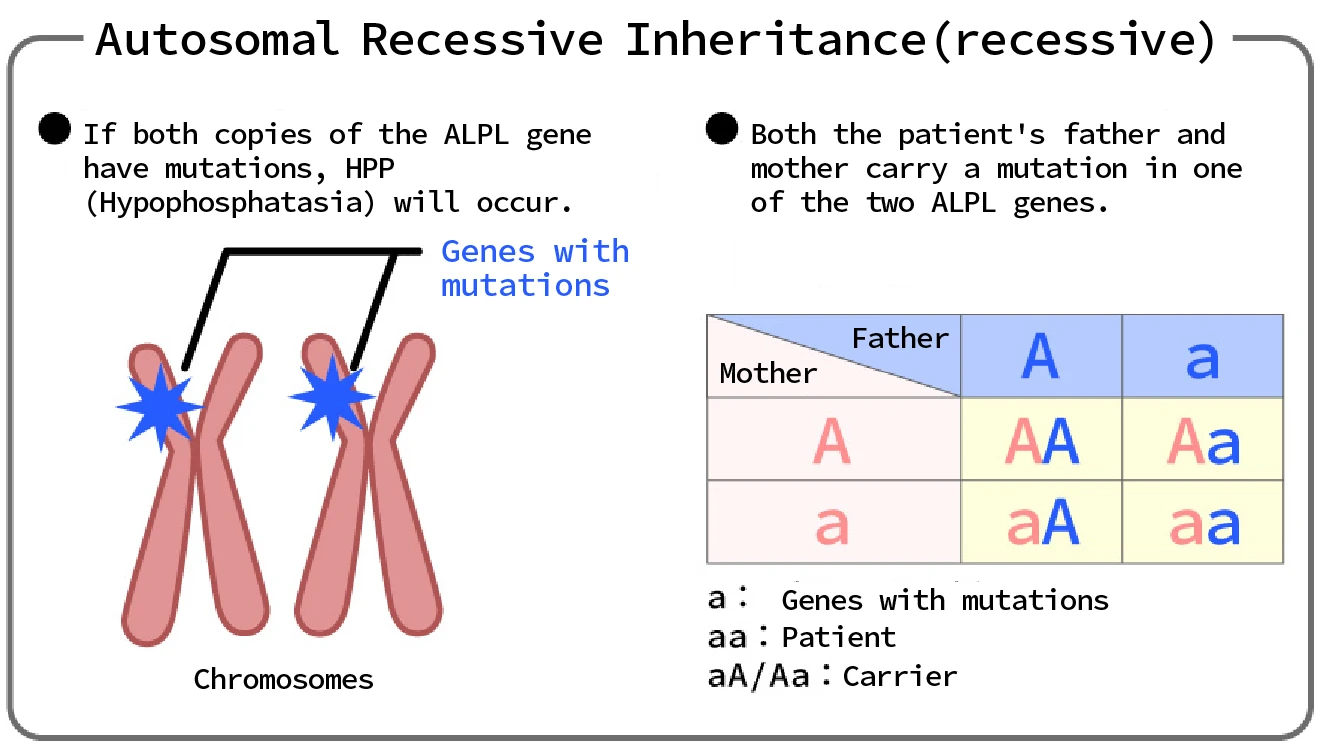
(2) Autosomal recessive genetic diseases
...If both of the paired genes on an autosomal chromosome are abnormal, the patient will develop the disease, but if only one gene is abnormal, the patient will be a carrier.
With recessive inheritance, a disease can only develop if an abnormality (mutation) is present in both copies (alleles) of a gene. This means that the phenotype can be masked by the normal allele.
[Phenotypic Expression]
In recessive inheritance, an abnormal phenotype only appears when the individual is homozygous (aa), where "a" represents the abnormal (mutated) allele and "A" represents the normal allele.
Heterozygotes (Aa) show a normal phenotype, but these individuals are called carriers and may pass on the abnormal gene to future generations.
[Patterns of inheritance]
For recessive genetic diseases, if both parents are carriers, the child has a 25% chance of developing the disease.
This is because in the combination of carriers (Aa x Aa), 25% of children will be homozygous (aa).
Also, 50% will be carriers (Aa) and 25% will be normal (AA).
[Example]
Cystic fibrosis: Mutations in the CFTR gene cause abnormal mucus secretion, leading to serious problems in the lungs and digestive system.
Phenylketonuria (PKU): Mutations in the PAH gene impair phenylalanine metabolism, causing intellectual disability and developmental delay.
(3) X-linked genetic diseases
...There is an abnormality in the X chromosome, which is a sex chromosome.
●Inheritance related to sex chromosomes
Single-gene disorders may also be linked to the sex chromosomes (X and Y).
These disorders have different inheritance patterns depending on the gender.
●X-linked recessive inheritance
In X-linked recessive inheritance, the abnormal (mutated) gene is located on the X chromosome.
This type of disorder is more common in males.
[Phenotypic Expression]
Males (XY) have only one X chromosome, so they have no normal alleles and only one abnormal allele (Xa) is needed to cause the disease.
Females (XX) have two X chromosomes, so they only need two abnormal alleles (XaXa) to cause the disease.
Those with only one abnormal allele (XaX) are carriers, but usually do not show symptoms.
[Patterns of inheritance]
When a carrier female (XaX) and a normal male (XY) are paired, there is a 50% chance that a boy will have the condition and a 50% chance that a girl will be a carrier.
When an affected male (XaY) and a normal female (XX) are paired, all girls will be carriers and all boys will be normal.
[Example]
Hemophilia: A disease in which bleeding becomes difficult to stop due to a deficiency of blood clotting factors.
Duchenne muscular dystrophy: A disease that causes progressive muscle weakness.
Overt (dominant) and recessive (recessive) inheritance are important concepts in the development of single-gene disorders.
Overt (dominant) inheritance requires only one abnormal gene to cause the disease, whereas recessive (recessive) inheritance requires both genes to be abnormal.
Understanding these differences provides a foundation for genetic disease risk assessment, genetic counseling, and treatment development.
Genetics or mutation
In the case of monogenic diseases, whether the onset is due to a new (de novo) mutation or hereditary causes varies by disease. In general, it is believed that hereditary causes are more prevalent.
In cases where the condition is inherited, the patient is more likely to inherit it from a parent who has the mutation. In cases where the condition is recessive, children can develop the disease even if only one parent has the mutation. In cases where the condition is dominant, children are more likely to develop the disease if only one parent has the mutation.
However, de novo mutations can also cause disease. De novo mutations are not usually inherited from parents, but rather occur in an individual's germ cells or during fetal development. Although de novo mutations can cause disease, these diseases are usually genetically unlikely to be recurring, making risk assessment based on family history difficult.
Thus, many monogenic disorders are primarily due to inheritance, and de novo mutations are relatively rare, but may vary depending on the specific disorder and mutation.
Disease Examples
●Achondroplasia
Achondroplasia is a genetic disorder characterized by abnormalities in cartilage that affect skeletal morphology and growth.
It is caused by mutations in the FGFR3 gene, which causes abnormal gene function and excessive suppression of bone growth, resulting in short stature and shortened limbs.
●Duchenne Muscular Dystrophy (DMD)
Muscular dystrophies refer to a group of disorders characterized by muscle degeneration and weakness.
Duchenne muscular dystrophy is caused by a mutation in the DMD gene on the X chromosome. This mutation results in insufficient production of dystrophin, a protein that supports muscles, resulting in impaired muscle structure and function.
●Huntington's Disease (HD)
Huntington's disease is a degenerative disorder of the central nervous system that causes impaired motor and cognitive functions due to the progressive death of nerve cells.
●Congenital Myasthenic Syndromes (CMS)
Congenital polymyositis is a group of disorders caused by dysfunction of the neuromuscular junction.
These disorders are caused by mutations in genes involved in the release and reception of neurotransmitters.
●Phenylketonuria (PKU)
Phenylketonuria is a metabolic disorder caused by abnormalities in phenylalanine metabolism.
The disease is caused by a deficiency in the phenylalanine hydroxylase (PAH) enzyme.
●Cystic Fibrosis (CF)
Cystic fibrosis is a genetic disease that primarily affects organs such as the lungs, pancreas, and digestive tract. The disease is caused by mutations in the CFTR gene. The CFTR gene codes for a protein that regulates chloride ion (anion) transport, and mutations in the gene disrupt normal chloride ion transport.
Symptoms of CF include chronic respiratory infections, reduced lung function, digestive tract problems (such as pancreatic insufficiency and intestinal blockages), difficulty gaining weight, and insufficient salt excretion. The disease shows a recessive inheritance pattern, and if both parents carry the mutation, their children may develop CF. The diagnosis of CF is based on genetic testing and clinical symptoms, and early detection and treatment are important.
CF now has advanced treatments, including symptomatic and drug therapy, which can improve the quality of life of patients. However, there is still no cure for the disease, and patients require ongoing management and treatment throughout their lives.
Diagnosis and Treatment
Diagnosis of single-gene disorders is made through family history and genetic testing. The cooperation of a genetic counselor or clinical geneticist is also important.
Treatment varies depending on the disease and symptoms, but generally aims to alleviate symptoms and slow progression. For example, physical therapy and certain drug therapy may be used. In addition, PGT-M allows embryos created by IVF to be examined for mutation status and transferred (pregnancy).
Single-gene disorders are discovered in the following ways.
Family history investigation
First, we investigate how the disease spreads within families. It is important to find out how many generations a particular disease has been transmitted within a family. Based on family history, characteristic inheritance patterns may be found.
Genetic analysis and gene mapping
To identify disease-causing genes, genetic analysis or gene mapping is used, which involves DNA sequencing and analysis with genetic markers. The goal is to identify which mutations in specific genes are associated with a particular disease.
Genetic counseling
Genetic counseling is the process of providing information related to genetic risk and genetic test results, including family history and genetic risk assessment, test interpretation, and disease risk and management information.
Functional analysis
When a mutation in a particular gene is found, functional analysis is performed to understand how the function of the gene is affected, which can include in vitro and in vivo experiments and analyses in cell and animal models.
Clinical Trials
When mutations in a particular gene are identified as being associated with a particular disease, clinical trials may be conducted to find ways to treat or prevent that disease.
Through these steps, it is confirmed that a specific gene mutation is associated with a specific disease, and research is then conducted to understand the disease and develop a treatment for it.
Latest research trends
Research into single-gene diseases is evolving with innovative approaches, such as the development of gene editing technology and new ssibilities for gene therapy.
This will hopefully lead to the development of new therapies that treat the genetic causes. In addition, rather than directly treating the cause of the disease, it is possible to examine embryos created through IVF (PGT-M) and select embryos that are not affected by the disease for implantation and pregnancy.
Summary
Monogenic diseases are diseases caused by mutations in individual genes and are diagnosed through genetic analysis and family history.
Treatments vary depending on the disease and symptoms, but generally aim to alleviate symptoms and slow progression. The latest research trends are expected to lead to the development of new treatments and strategies to improve the quality of life for patients.