


What is Prenatal Fetal DNA Paternity Testing?
About A paternity test can be performed from the beginning of pregnancy without damaging the fetus.
Paternity testing is performed by comparing fetal DNA with mother's DNA, and potentially father's DNA, by next-generation sequencing (NGS).
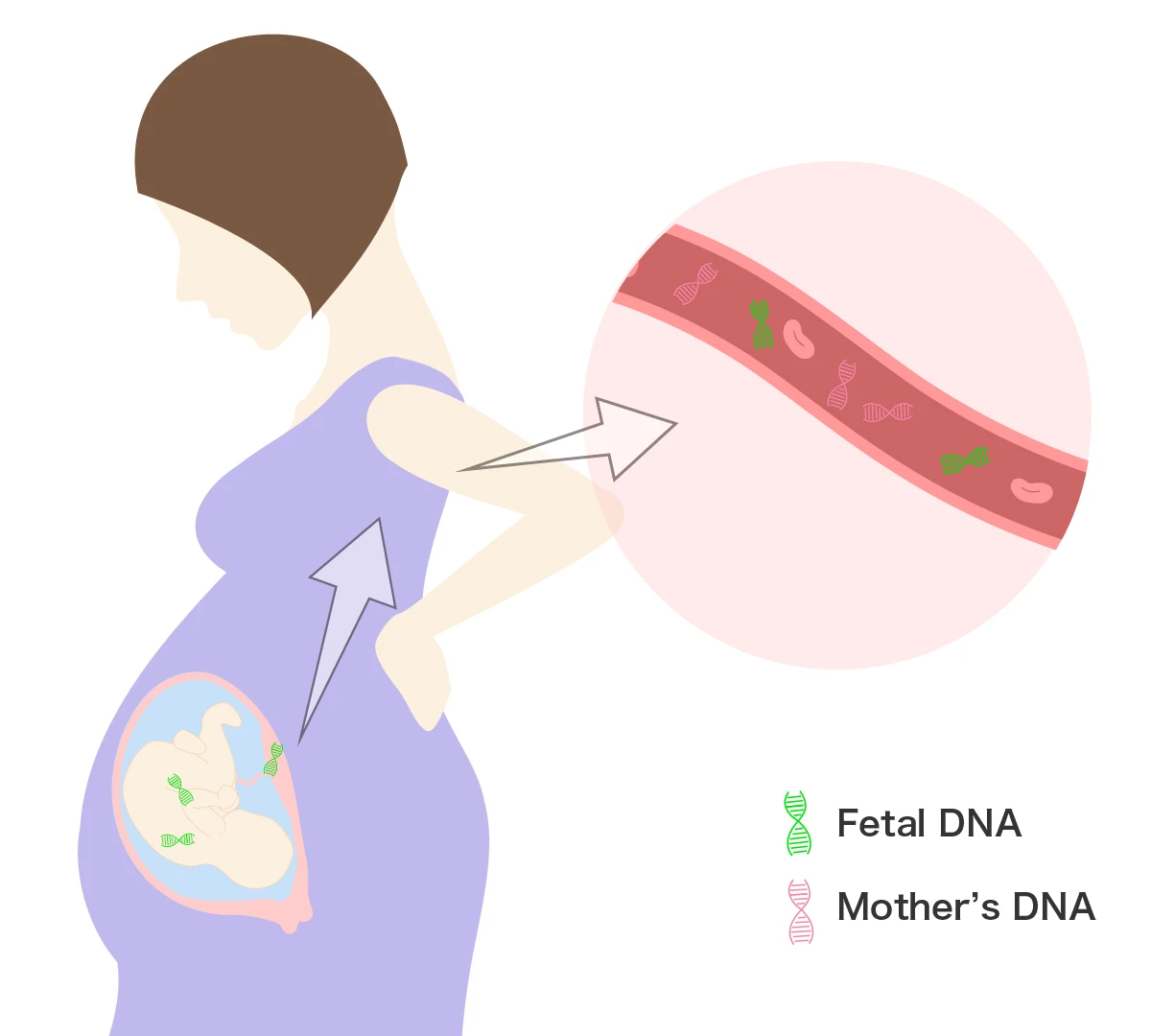
Fetal DNA can be tested by simply collecting blood from the mother without damaging the fetus.
How can a fetal DNA test be done with the mother's blood?
This is because the fetal DNA is contained in the mother's blood.
From the 6th week of pregnancy, fetal DNA begins to flow into the mother's blood through the placenta.
After that, the amount of fetal DNA in the maternal blood increases in proportion to the gestation period, and reaches a high level after the 14th week of gestation.
Therefore, fetal DNA is extracted from maternal blood and used for analysis.
Methods
MethodsTesting Period
It can be tested from the 7th week of pregnancy at the earliest.
However, the amount of fetal DNA in maternal blood varies greatly from person to person. The earlier the test is performed, the less fetal DNA can be recovered, and sometimes in early cases there is not enough for the test.
Also, in a case where the fetus has already died (for example due to ectopic pregnancy) fetal DNA will not be found in the mother’s bloodstream.
Therefore, please have a medical examination in advance to confirm that you have a normal pregnancy, and then collect blood after the 7th week of pregnancy.
Blood will be collected at a medical institution designated by us.
Blood Collection
As with regular blood tests, blood is generally drawn from the arm.
However, if it is difficult to draw blood from the arm, blood may be drawn from another location where it is easier to draw blood.
DNA Collection
Using the swab (included in the test kit), gently rub the inside of your cheek to collect buccal mucosa cells (cells from the inner surface of your cheek). Submit this sample, and we will extract DNA from it.
If cooperation from a potential father is unavailable, DNA may sometimes be recovered from items like toothbrushes or hair for testing. Please feel free to inquire about what types of samples can be used.
Regarding Appraisal
Medical EvaluationAccuracy of appraisal
For affirmation of parent-child relationship, paternity affirmation probability of 99.99% or more is judged, and for denial, paternity affirmation probability of 0% is judged as the minimum guaranteed accuracy.
[Supplement]
Theoretically, 100% certainty in paternity testing is impossible. There is no practical way to invalidate results obtained with a 99.9% probability of paternity.
However, if the man believed to be the father is an identical twin, testing may be difficult because identical twins are detected as having the same genotype. Additionally, testing may be difficult if sufficient DNA cannot be recovered.
Types of appraisal
here are two types of appraisal, "Private appraisal" and "Legal appraisal”.
[Private appraisal]
An appraisal conducted for the purpose of personal confirmation. If it is not required for submission to public institutions or similar entities, this service is sufficient.
[Legal appraisal]
An appraisal intended to be used as proof of parent-child relationship in mediation and trials.
There is no difference in the accuracy of the appraisal results.