


What is Prenatal Fetal Sex Determination?
AboutThis is a DNA test that examines the sex of a newly growing fetus from the beginning of pregnancy using the blood of a pregnant mother.By simply collecting blood from the mother, the test can be performed without damaging the pregnancy.
How can a fetal DNA test be done with the mother's blood?
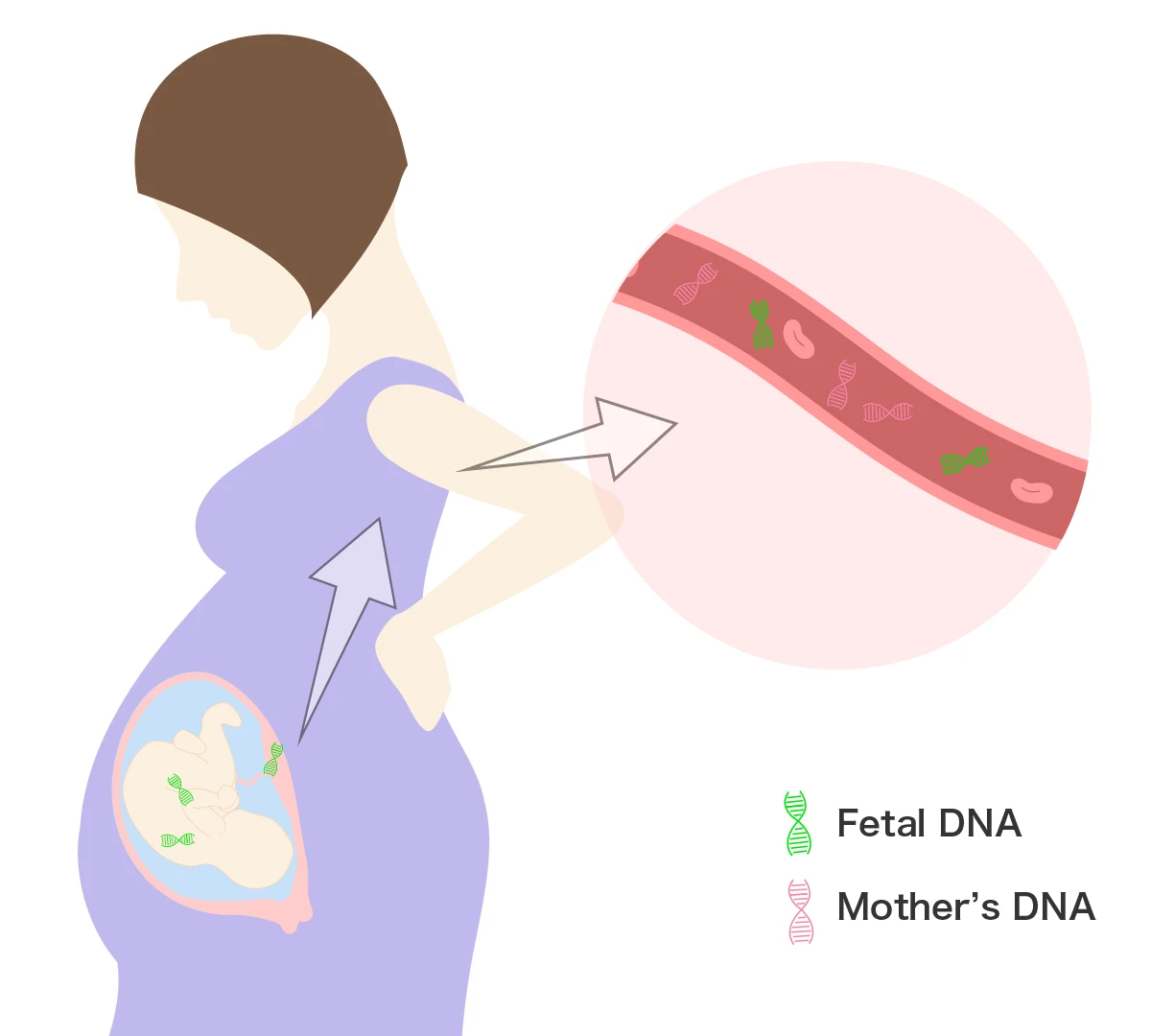
Fetal DNA is contained in the mother's blood.
It begins to flow through the placenta into the mother's bloodstream from the 6th week of pregnancy. After that, the amount of fetal DNA in the maternal blood increases in proportion to the gestation period, and it reaches a high level after the 14th week of gestation. Fetal DNA can be analyzed by extracting DNA from maternal blood and distinguishing it from maternal DNA.
There are two types of human sex chromosomes, the X chromosome and the Y chromosome. The combination of XX is for girls and the combination of XY is for boys.
Therefore, if the fetal DNA can detect a valid signal on the Y chromosome, it is a boy, and if it cannot be detected, it is a girl because there is no Y chromosome.
Benefits & Risks
Benefits & RisksBenefits
- No risk of harm to the fetus
- Early determination of fetal sex
This test requires only a blood sample from the mother and does not have any direct impact on the fetus.
Compared to standard ultrasound examinations, this test allows fetal sex to be determined at an earlier stage of pregnancy.
With routine ultrasound, fetal sex is generally estimated based on genital development around the 16th week of pregnancy and becomes clearer around the 28th week; however, accurate assessment may be difficult depending on factors such as fetal position.
In contrast, this test analyzes fetal DNA and can determine fetal sex from as early as the 7th week of pregnancy, potentially allowing for earlier and more accurate confirmation.
Risks
- Variability in accuracy due to fetal DNA fraction
The amount of fetal DNA varies among individuals, and if the test is performed too early in pregnancy, the accuracy of the results may be reduced.
Methods
MethodsTesting Period
It can be tested from the 7th week of pregnancy at the earliest.
However, the amount of fetal DNA in maternal blood varies greatly from person to person. The earlier the test is performed, the less fetal DNA can be recovered, and sometimes in early cases there is not enough for the test.
Also, in a case where the fetus has already died (for example due to ectopic pregnancy) fetal DNA will not be found in the mother’s bloodstream.
Therefore, please have a medical examination in advance to confirm that you have a normal pregnancy, and then collect blood after the 7th week of pregnancy.
Blood will be collected at a medical institution designated by us.
Blood Collection
As with regular blood tests, blood is generally drawn from the arm.
However, if it is difficult to draw blood from the arm, blood may be drawn from another location where it is easier to draw blood.